
Disclaimer: This article is for educational purposes only. It demonstrates how to get compensation for delayed and cancelled flights based on our personal experience and may contain referral links at no extra cost to you.
Delayed and cancelled flights are frustrating, especially when the disruption exceeds four hours or leaves you stranded. However, airlines hate delays and cancellations even more than passengers do! While for passengers, a disrupted flight usually means friction in their travel plans, for airlines, it can cost thousands of dollars in client compensation alone.
Unfortunately, most flyers don’t know their rights. When an airline proposes a simple food voucher for a cancellation or long delay, many are happy with that, even though they might be eligible for hundreds of dollars! In this article, we explain how to apply for compensation and whether you should do it on your own or use third-party services. Bookmark this article for future reference, but also check your history—you can get compensated even if your flight was delayed or cancelled a year ago!
Summer 2023: The Lynx Experience
We had just finished an amazing trip to Newfoundland with Lynx (just a few months before they went bankrupt). While waiting for our flight at the airport, we received an email: our flight was delayed. Four hours. It could be worse, but it meant a wasted workday. Fortunately, the delay was only four hours and wasn't extended further—as often happens—but it still caused some inconvenience. That was when we learned that according to the Canadian Air Passenger Protection Regulations (APPR):
Airlines should give passengers as much notice as possible that their flight will be delayed or cancelled. If an airline informs the passengers 14 days or less before their original departure time, they will have to compensate the passengers for the inconvenience of the disruption. The amount of compensation depends on how late the passenger arrives at their destination, compared to the arrival time indicated on their original ticket.
Large airlines must pay:
- $400 if the passenger arrives three or more hours late, but less than six hours;
- $700 if the passenger arrives six or more hours late, but less than nine hours;
- $1,000 if the passenger arrives nine or more hours late.
Small airlines must pay:
- $125 if the passenger arrives three or more hours late, but less than six hours;
- $250 if the passenger arrives six or more hours late, but less than nine hours;
- $500 if the passenger arrives nine or more hours late.
Passengers who choose to take a ticket refund instead of alternate travel arrangements must still be compensated for inconvenience if the disruption was within the airline’s control. Large airlines must pay them $400 and small airlines, $125.
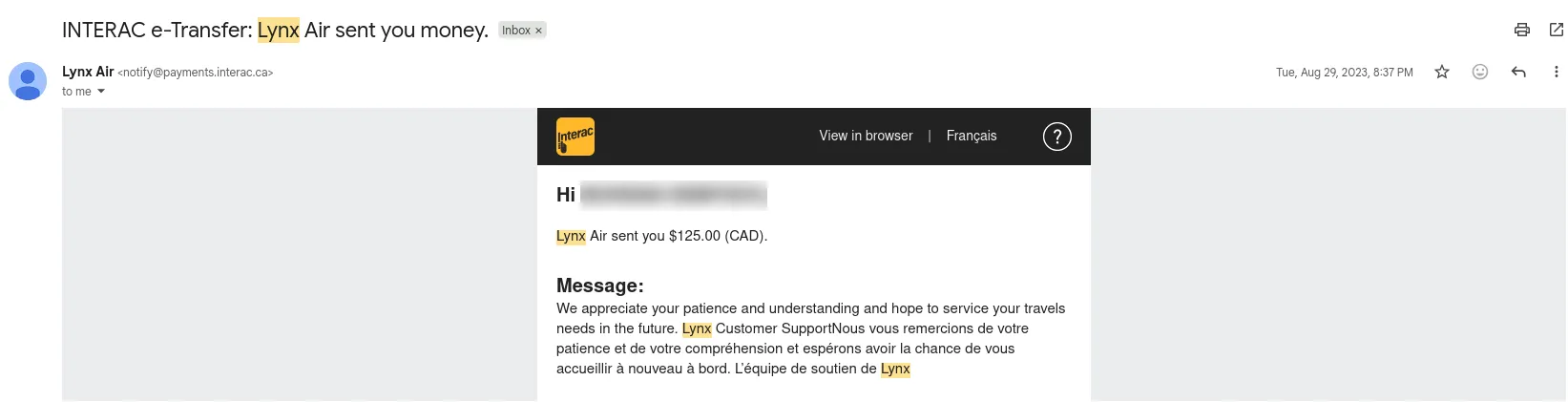
The process was easy for us. We simply filled out the form on the Lynx website, and within a few weeks, we received $125 per person. It wasn't a fortune, but it covered our ticket price (yes, we managed to fly to St. John’s for $125 round trip! 🙂).
August 2022: The European Struggle
However, a few months prior, it hadn't been so easy. August 2022. Our flight from Warsaw to Paris was delayed by more than four hours. The airline provided a simple food voucher that barely covered a sandwich and water. This was when we first learned about flight delay compensation in general, and EU regulations specifically:
| Distance | Delay at arrival at final destination | Compensation |
|---|---|---|
| 1,500 km or less | 3 hours or more | €250 |
| More than 1,500 km within the EU and all other flights between 1,500 and 3,500 km | 3 hours or more | €400 |
| More than 3,500 km | 3 hours or more | €600 |
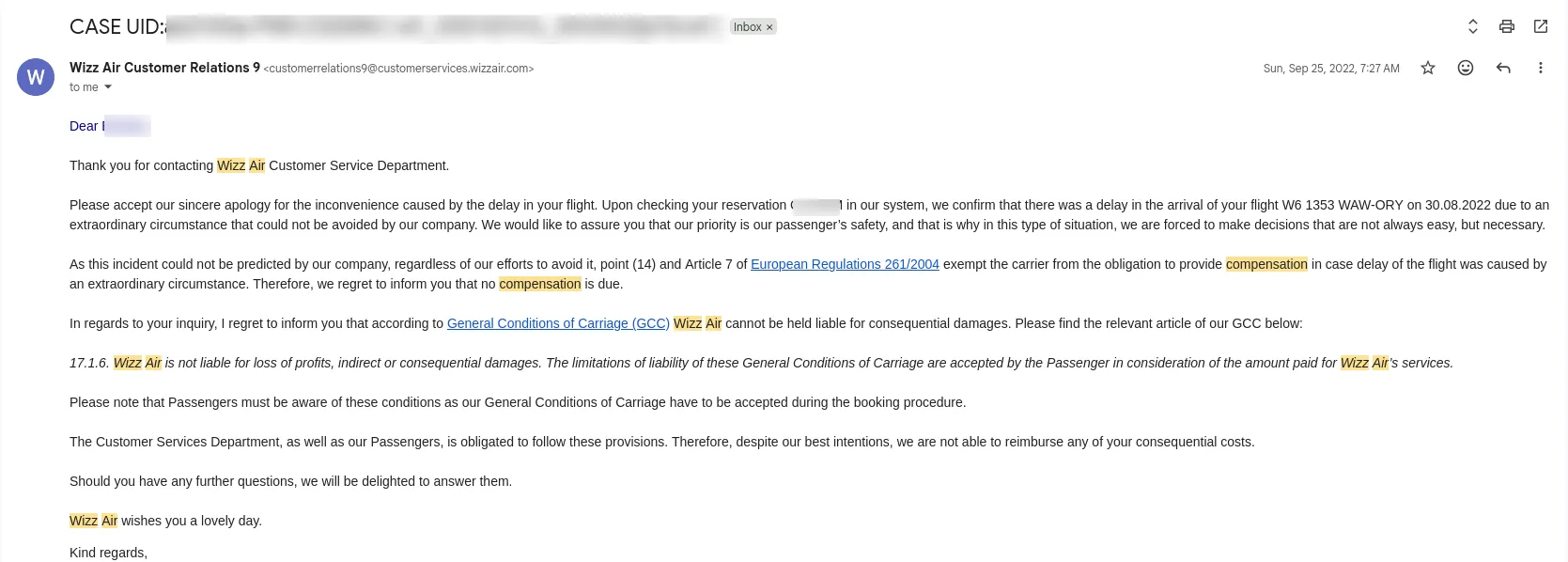
However, it was a long fight. Initially, we filled out the form on the official Wizz Air website, only to find out a few weeks later that we were "not eligible" for compensation:
Turning a "No" into a "Yes" with AirHelp
But we didn't give up! We decided to try AirHelp, a leading online service designed to help passengers secure compensation for delayed, cancelled, or overbooked flights. They often pursue claims under regulations like EU261. Operating on a "no win, no fee" basis, they handle legal negotiations with airlines to recover up to €600 per passenger.
We had nothing to lose. The airline had already denied our claim, so the worst-case scenario was another denial. The best case? We get our compensation minus the service fee.
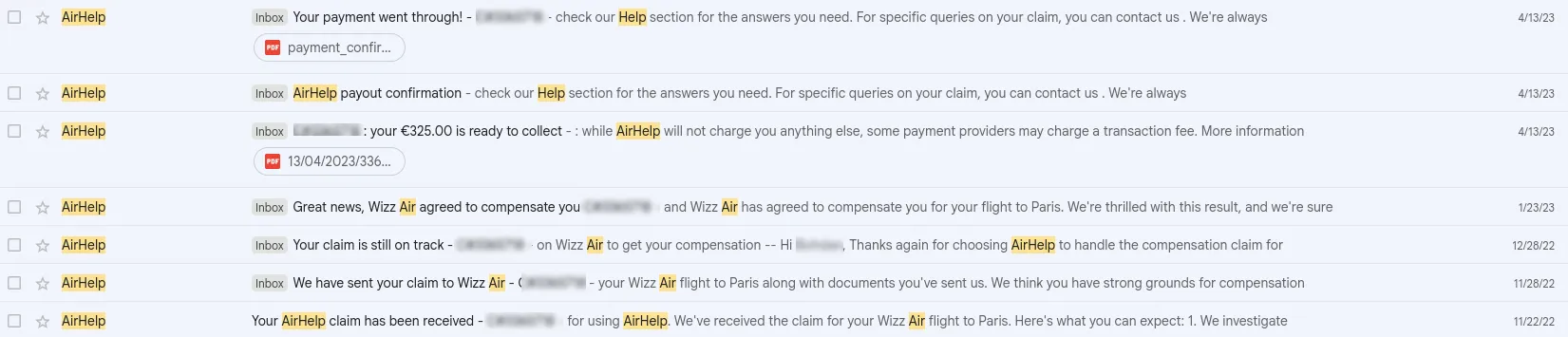
And we were right! After filling out a short online form and waiting a few months, we received compensation that covered our tickets from Warsaw to Paris several times over! 🙂
All process
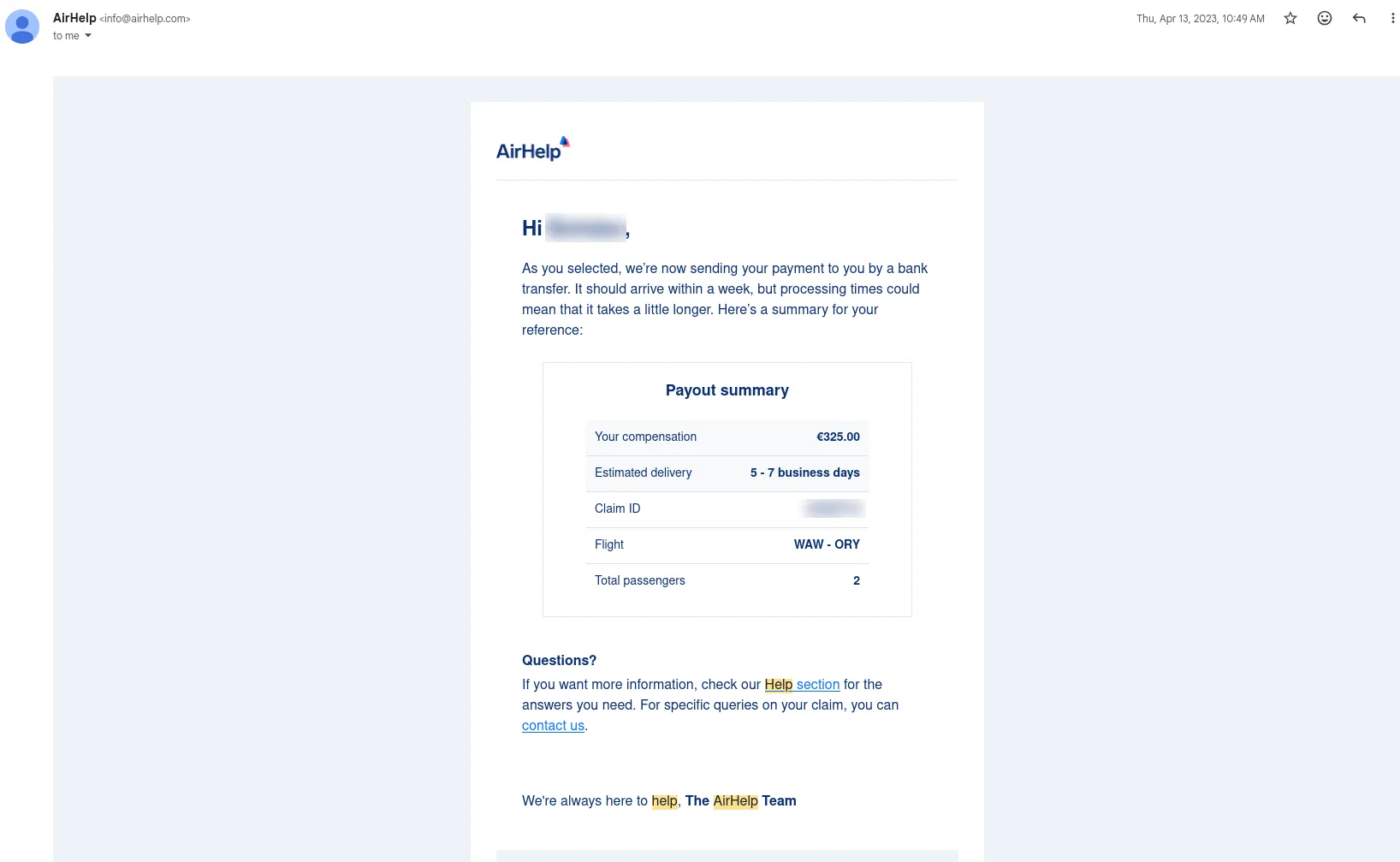
Final result
Practical Advice for Getting Compensated
Now that you've heard our experience—both getting compensated on our own and using third-party services—we want to provide more advice and practical information.
1. Time Limits and DIY Application
First and foremost, you can often apply within one year (or more, depending on the jurisdiction) of the flight delay or cancellation. You should prioritize applying on your own to keep the full compensation. Usually, the forms requested by airlines are simple and don’t require any legal knowledge.
2. Eligibility and "Extraordinary Circumstances"
Passengers are generally not eligible for compensation if the delay is due to circumstances outside the airline's control, such as:
- Weather conditions (snowstorms, lightning)
- Third-party strikes (airport staff, Air Traffic Control)
- Medical emergencies or security threats
- Decisions made by the pilot for safety
- Unforeseen technical issues found right before takeoff
The first three are pretty clear. However, "safety decisions" and "technical issues" can be gray areas. If you hesitate, apply anyway. The worst that can happen is they say no! 🙂
3. Know Your Regulations
Different regions have different rules. We've discussed Canadian and EU regulations:
-
When EU Regulations (EC 261) Apply:
- Flights Departing from the EU: Covered regardless of the airline's nationality (e.g., Air Canada from Paris to Toronto).
- Flights Arriving in the EU from outside: Covered only if you are flying with an EU-based airline (e.g., Air France from Toronto to Paris is covered; Air Canada is not).
- Flights within the EU: Always covered.
-
When Canadian Regulations (APPR) Apply:
- To, From, and Within Canada: APPR applies to any flight that lands or takes off at a Canadian airport, regardless of the airline.
-
The Overlap:
- If you are flying between Europe and Canada on an EU airline, you might be protected by both. However, you cannot "double dip." We recommend applying for EU compensation as the payout is usually higher.
What About Other Regions?
We focused on Canada and the EU, but what about elsewhere?
- Africa, Asia, South America: There are no unified continental rules. You must check specific country regulations.
- Australia: Check policies here.
- USA: Check the Department of Transportation Dashboard.
Final Thoughts
If you can't get compensation on your own, or simply don't want to deal with the airline, services like AirHelp can handle the work for a fee (deducted from your compensation). If they don't win, you don't pay. Since AirHelp succeeded with Wizz Air after we were rejected, we highly recommend them.
We wish you smooth, on-time flights! But if delays or cancellations happen—now you know your rights!