
Disclaimer: This is not a sponsored post or an affiliated article. I don’t get a kickback if you sign up for these cards. I’m just a traveler who hates seeing "convenience fees" on my bank statement, and this is the setup that works for me in 2026.
Many international carriers and hotels bill in their local currency (like USD, EUR, or GBP). If you use a standard Canadian card to book, your bank will likely slap a 2.5% "Foreign Transaction Fee" on top of the price before you even leave your house.
Then, once you land, the hidden costs continue. I watched a significant chunk of my travel budget disappear into a black hole of ATM surcharges and bank markups. Here is the exact two-card strategy I use to stop the bleed on both my bookings and my cash withdrawals.
My Two-Card System: The "Paid" Powerhouse vs. The "Free" Essential
I split my strategy between spending (bookings, hotels, dinners) and withdrawing (markets, street food, small shops).
1. For Bookings & Payments: Scotiabank Passport Visa Infinite (Paid)
This is my workhorse for the "big" stuff. While it does have a $150 annual fee, the savings on transaction fees and the added perks usually outweigh the cost if you travel even once or twice a year.
- No Foreign Transaction Fees: When a flight or hotel is billed in a foreign currency, I use this card. It waives the standard markup, meaning I pay the real exchange rate without the extra bank fee.
- Travel Insurance & Lounges: I use this for all my major bookings because the insurance coverage is top-tier for things like flight delays or lost luggage. Plus, it includes 6 free airport lounge passes per year.
- The "Global Alliance" Hack: If you also have a Scotiabank debit card, you can use partner ATMs (like Bank of America in the US, Barclays in the UK, or BNP Paribas in France) to have the international access fees waived. It’s a great backup if you’re in a country where these partners are common.
2. For Cash: Wealthsimple Cash Card (Free)
Even in 2026, cash is still a necessity for the best street food and local markets. For this, I never use my credit card (to avoid high-interest "cash advances"). I use the Wealthsimple Cash Card.
- $0 Annual Fee: This card is completely free to get and hold. There is no monthly cost, making it an essential tool for any Canadian traveler.
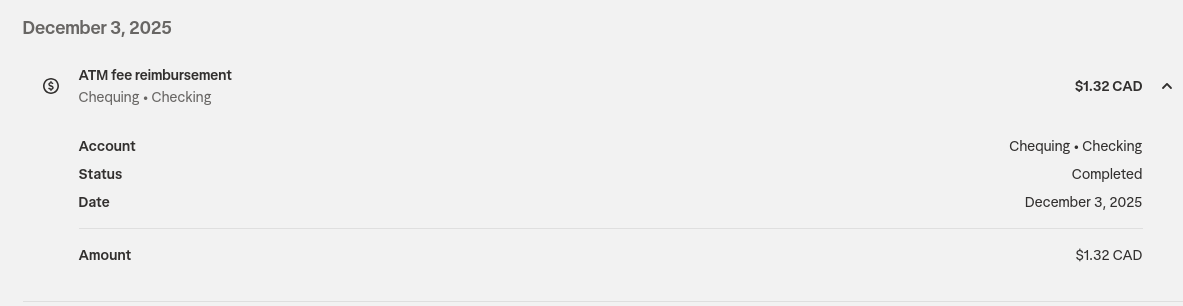
- Unlimited Fee Reimbursement: This is the game-changer. Wealthsimple offers international ATM fee reimbursements. If a machine in another country charges you a fee to withdraw your money, Wealthsimple puts that money back in your account within a few business days.
- Prepaid Security: Since it’s a prepaid card, I only move the "pocket money" I need into the account. If the card is ever lost or stolen, your main savings remain untouched and secure.
The "Golden Rule" I Never Break
Every time you pay for a meal or use an ATM abroad, the screen will ask you a sneaky question:
"Would you like to be billed in Canadian Dollars (CAD) or Local Currency?"
Always choose LOCAL CURRENCY. If you choose CAD, the merchant or ATM owner uses "Dynamic Currency Conversion" (DCC). This allows them to set the exchange rate, which is almost always worse than what your bank would give you. By choosing the local currency, you force the machine to let your bank handle the conversion at the fair market rate.
Summary: Your Savings Checklist
- Book your flights and hotels (if they are billed in a foreign currency), and daily expenses like restaurants or supermarkets using a No-FX Credit Card (like the Scotia Passport) to save on the transaction fees and secure your travel insurance.
- Move your spending money into a free Wealthsimple Cash account before you fly.
- Withdraw cash in the local currency once you land and let your card provider handle the fees.
Stop paying the "Bank Tax" on your vacations.