
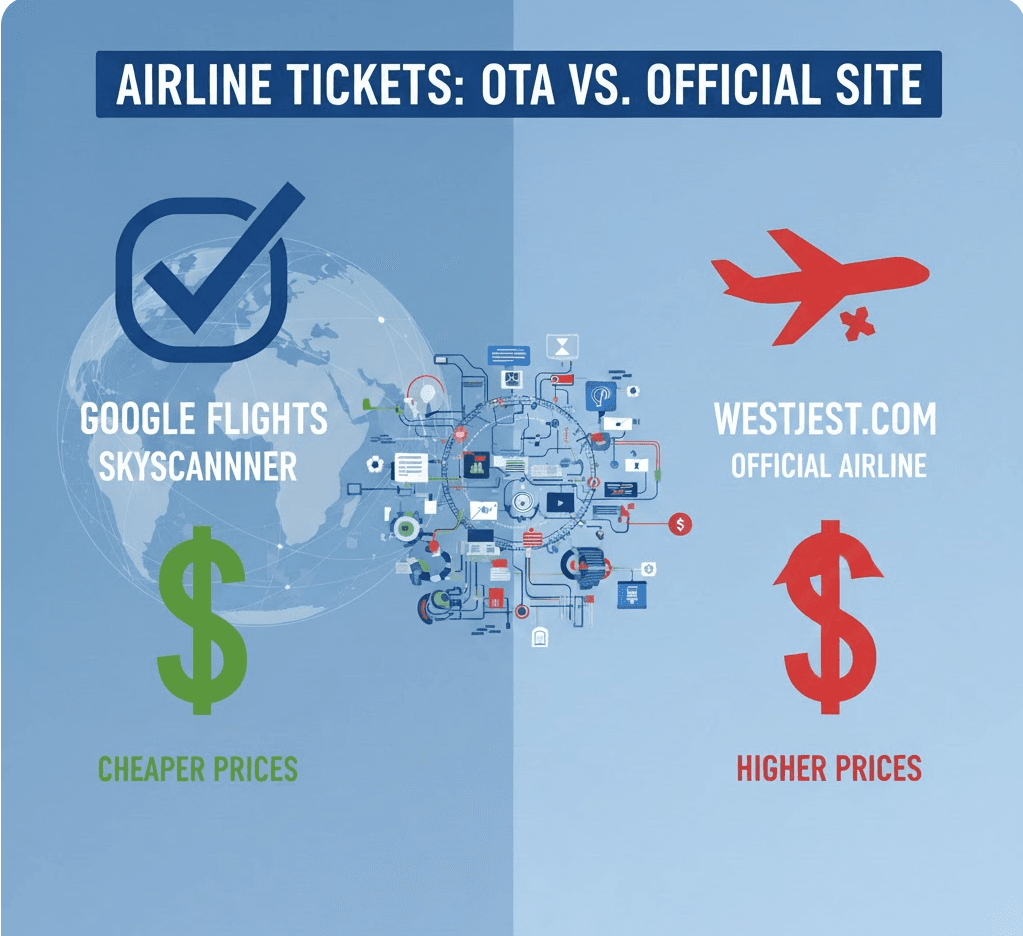
Disclaimer: This article is for educational purposes only to demonstrate the difference in fares through official websites and online travel agencies. It does not encourage readers to use any of the suggested services, but simply explains why tickets on Online Travel Agencies are often significantly cheaper and their associated costs.
Frequent users of meta-search engines (Google Flights, Skyscanner, Kayak, and others) may notice that in many cases, especially for non-ultra-low-cost carriers, ticket prices are cheaper—sometimes significantly—than on official airline websites. This sounds counterintuitive, right? Why would tickets sold through middlemen who earn fees be cheaper than from the official seller?
Yet in some specific cases, the difference can be $100 or more! We have traveled extensively across and from Canada, and this noticeable difference has appeared most prominently with WestJet. In fact, we've seen the exact same flights, same class, literally everything identical, priced at $105 more on WestJet's official website compared to online travel agencies.
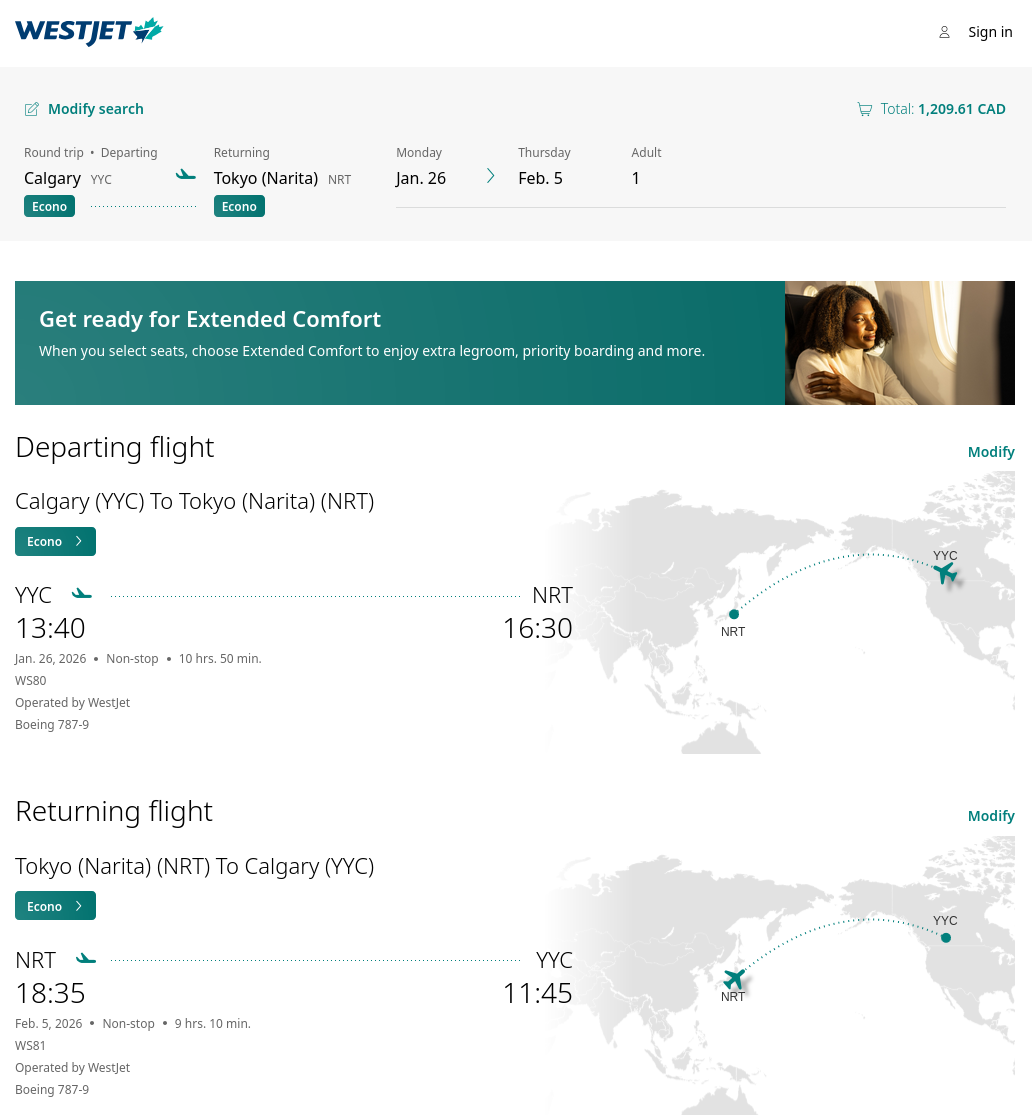
Official website
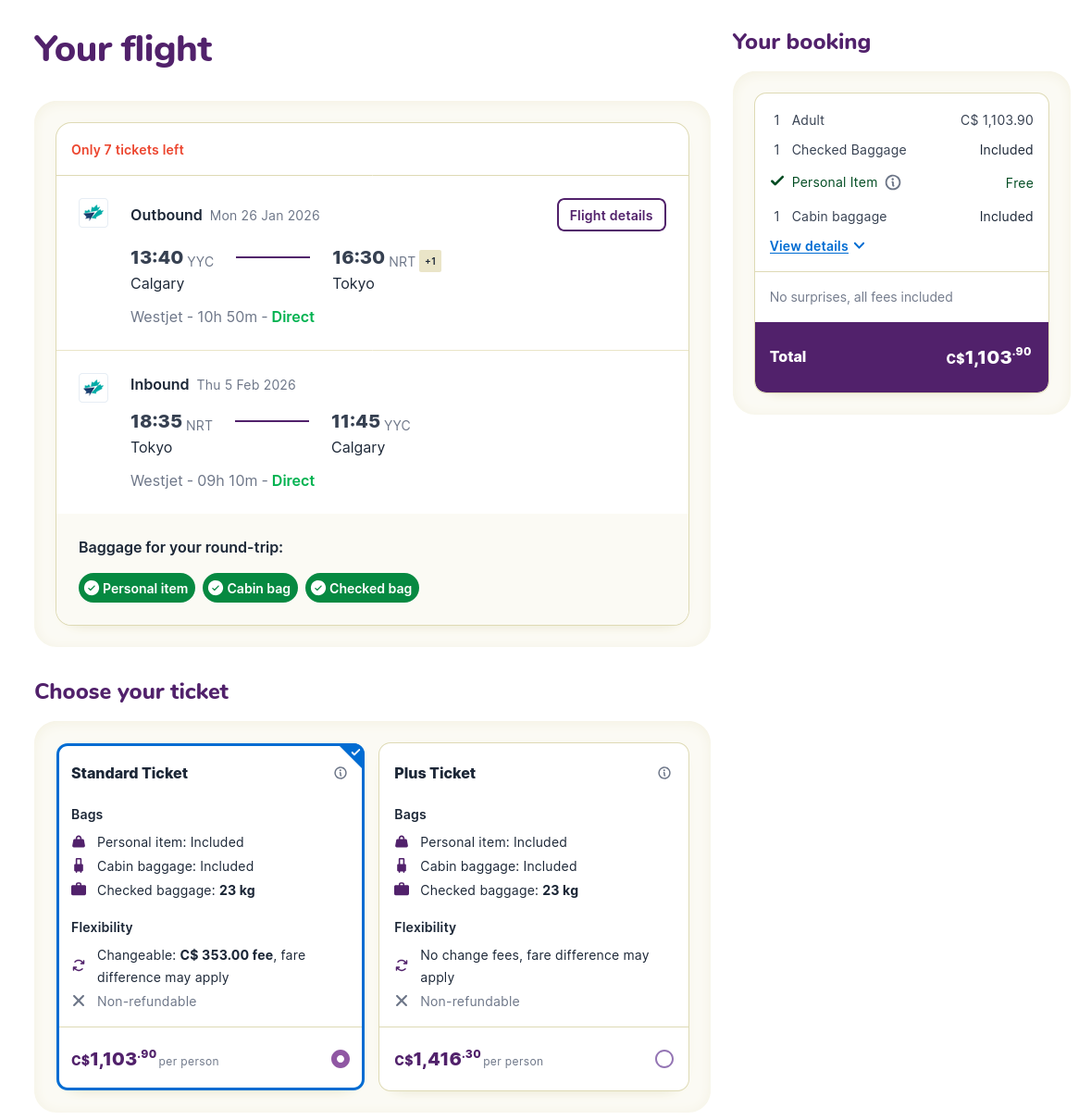
Online Travel Agency
We researched to better understand why this happens, and while we didn't get an exact answer, we found several common reasons why it's sometimes cheaper to buy through an Online Travel Agency (OTA) than on the official website.
NDC (New Distribution Capability)
To understand why NDC is lowering prices on OTAs compared to airline websites or traditional agents, you need to look at the "technological shift" happening in the travel industry.
What is NDC?
Developed by IATA (International Air Transport Association), NDC is an XML-based data transmission standard. Before NDC, almost all flight data was sent using EDIFACT—a rigid, 1980s-era protocol that only allowed for basic information (price, schedule, availability).
How NDC Creates Cheaper Prices for OTAs
The "game changer" aspect comes down to dynamic pricing and cost avoidance, particularly through bypassing the "GDS Tax":
Bypassing the "GDS Tax"
To understand this advantage, you first need to know what GDS (Global Distribution System) fees are. GDS platforms like Sabre, Amadeus, and Travelport act as intermediaries between airlines and travel agents (including many OTAs). Think of them as the "backbone" of the traditional travel booking system—when a travel agent searches for flights, they're typically querying a GDS system, which then queries the airline's reservation system.
For this service, GDS companies charge airlines a fee for every booking segment (typically $3–15 per segment, depending on the route and airline). These fees add up quickly, especially for complex itineraries. To offset these costs, airlines often add a "GDS surcharge" or "distribution fee" to tickets booked through the traditional EDIFACT system—essentially passing the cost onto the consumer.
Now, here's the key point: While official airline websites don't use GDS for direct bookings (they connect straight to their own reservation systems), airlines often maintain uniform pricing across all distribution channels. This means the official website price may include a markup that accounts for the GDS fees the airline pays when tickets are sold through other channels. It's a way to ensure price parity and offset the costs they incur from the broader distribution network. Additionally, some airlines price their official websites higher to account for the higher operational costs of maintaining direct booking infrastructure or to protect relationships with travel agents who still use GDS systems.
The NDC Advantage: When an OTA connects directly to an airline via an NDC API, they bypass the GDS entirely. This means the airline doesn't pay GDS fees for that booking, and they can choose to pass those savings on to the OTA (and ultimately to the customer). The OTA can then list the flight on meta-search systems for less than competitors still using the old GDS system, and crucially, less than the airline's own website which may still be priced to account for GDS-related costs. This is one reason why you might see WestJet flights cheaper on OTAs that have adopted NDC technology.
2. The "Loss Leader" Strategy
In the world of meta-search, the #1 spot is everything. Most users click the first or second cheapest option and never look further.
- Buying the Customer: An OTA might realize that acquiring a new customer through Google Ads costs $50, but "winning" a customer on Google Flights/Skyscanner/Kayak by being $20 cheaper than the airline only costs them that $20 difference.
- Negative Margins: Large OTAs will sometimes deliberately sell a ticket at break-even or even a slight loss.
- The "Hook": Once you click their link, you enter their ecosystem. Their goal is to make the profit back on ancillaries:
- Markup on Baggage: They might charge $60 for a bag that costs $50 on the airline's site.
- Service Fees: Charging for "Premium Support" or "Flexible Rebooking."
- Cross-selling: The real money is in the hotel or car rental they try to sell you on the confirmation page, where profit margins are 15–20% (compared to ~2% on a flight).
3. Bulk & Consolidator Fares
Airlines hate flying empty seats. To ensure a "baseline" of occupied seats on certain routes, they sell blocks of tickets to wholesalers (consolidators).
- Net Fares: The airline sells large blocks of seats (say, 500 seats) to a wholesaler at a "net fare"—a price far below what is publicly available.
- The Agreement: The wholesaler sells these to OTAs. The catch? These fares are often "private," meaning they shouldn't be advertised as a standalone price. However, OTAs find ways to show them in search results.
- Why they are cheaper: These aren't just "discounted"; they are a different class of ticket altogether, sold at wholesale prices.
Sometimes these reasons are combined, which is why we can see really attractive "discounts" on certain routes and airlines.
The Hidden Costs and Risks: The "Middleman Trap"
But there must be a catch, right? Right. Everything has its price. There are significant "hidden costs" and risks when booking through OTAs. In the travel industry, this is often called the "Middleman Trap." Here are the primary disadvantages:
1. The "Customer Support Ping-Pong"
This is the most common and frustrating issue. When you book via an OTA, they "own" the reservation, not you.
- The Conflict: If a flight is cancelled or delayed, the airline will often tell you, "You booked through a travel agent; you must contact them to rebook."
- The Reality: If you booked through a small, budget OTA to get that lowest price, you may find yourself waiting on hold for hours with a call center in a different time zone, while people who booked directly with the airline are being helped at the airport counter.
2. Double Change/Cancellation Fees
Most OTAs add their own administrative fees on top of whatever the airline charges.
- The Math: If an airline charges $100 to change a flight, the OTA might charge an additional $50–$75 "processing fee."
- Strictness: While airlines sometimes waive fees for "acts of God" (weather, family emergencies), budget OTAs rarely do because those fees are a core part of their profit model.
3. Refund Delays
If a flight is cancelled and you are owed a refund, the process differs significantly:
- Direct: The airline refunds your credit card in 7–14 days.
- OTA: The airline refunds the OTA, and then the OTA has to refund you. This can take months, and some OTAs will try to force you to take "Agency Credit" instead of cash.
Our Personal Experience
We have flown with tickets booked through OTAs dozens of times and had problems only once. When traveling across Brazil, we saved around $150–200 per person in total for all our flights. Even though we had no issues with almost all of them, one flight was cancelled a few weeks before the trip, and rebooking required significant effort to get help from customer support. Everything worked out, but it was stressful at times. Do we regret our decision? Not really. The savings were worth it for that particular trip.
When it comes to WestJet specifically, we have flown with them many times and booked on their official website only once—when the price difference was minimal ($500 on the official website vs. $480 on the agency). That $20 difference didn't justify the hassle of dealing with a third party, while in other cases we have been happy to save extra dollars while also understanding all the risks.
We also noticed something important: if you book a WestJet round-trip flight via an OTA, they often issue it as two separate one-way tickets. This means your flights are not connected from WestJet's perspective. We're not saying it's necessarily bad or good; however, you may want to take this into consideration when making your own decision, especially if you're concerned about itinerary protection or need to make changes.
Our strategy has evolved over time. We always assess all risks before booking—we never book flights for brand-new routes or during winter when the risk of cancellation is higher, but we happily book tickets for "hot" routes that have been reliably operating for years and have very low risk of cancellations. Also, we almost never book any extra services like premium seats or extra luggage through OTAs, so we are not "vulnerable" to their markup on these services.
Most importantly, we always realize—if for some reason the flight is cancelled, we're going to deal with the consequences and we accept that risk. Having proper expectations is key.
Bottom Line
This article is not meant to encourage or discourage you to use OTAs, but to help you understand why the WestJet deals we publish (and we publish them a lot!) are often cheaper on online travel agencies, and to help you decide whether you are ready to "trade" your full control over the situation to save money, or rather pay more on the official website to have more peace of mind.